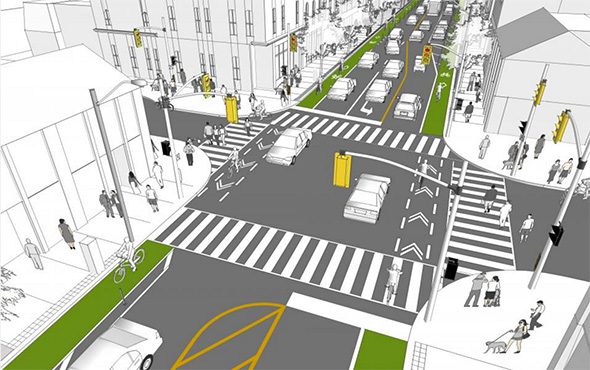
• It Doesn’t Matter Who Pays for Roads

    In any discussion about making space for alternative transportation modes – whether buses, trams, or bikes – the likelihood of someone retorting, “but drivers pay for roads!” quickly approaches 100%.

    The implication here is that drivers have a special entitlement to road space on account of them being the primary (and some imagine, exclusive) financiers of roads. Those who don’t own cars – cyclists and public transit users – supposedly don’t pay for roads, and thus have little to no claim to use them, let alone demand exclusive space like a bike or bus lane.

    I argue this is actually besides the point, but to labour this side point: numerous analyses have pointed out that the vast majority of drivers don’t come anywhere close to covering their road costs, whether through driver-specific fees, tolls, or taxes (and this is simply for infrastructure and maintenance, ignoring externalities and opportunity costs). In fact, in various jurisdictions, it’s non-drivers who are arguably paying too much for roads.

    There are a few simple reasons for this. First, in most municipalities, roads aren’t funded through any driver-specific revenue stream, they are funded through property taxes – which everyone pays, car owner or not. Where driver-specific fees and taxes are earmarked for roads, they don’t cover full costs. In the U.S., on average, they cover about 39% (though this is highly variable at the state-level). The rest are covered through various kinds of non-driver-specific tax revenue.

    But perhaps the most simple reason: for most people road use is subsidized. And for emphasis: driving is subsidized

    When any service, resource, or infrastructure is funded mainly by taxes, the taxes that most users pay don’t cover their cost of use, whether it’s a park, a library, a school, or a hospital. Simply put: wealthier people subsidize less wealthy people. Where exactly you need to fall in the tax paying bracket to cover your public costs differs on jurisdiction (and how taxes are earmarked for different areas of the budget), but in general it’s well above the median. To be sure, there’s nothing wrong with this – in fact, it’s a good thing: this is how a functioning society needs to work.

    So, who pays for roads? Everyone! But some people pay more. And most people don’t pay enough to cover their own road costs.

    But here’s the thing: it doesn’t matter who pays for roads. Debating who is more entitled to use roads skips over a much more fundamental question: should we be building so many roads in the first place? (And roads designed in particular ways to prioritize car transport?)

    Instead of, “Who is entitled to use road space?” a better question is, “How should we use this public space?”

    Even if roads were funded exclusively through user-fees (which incidentally, would be a sure-fire way to get people to stop driving, since roads are enormously subsidized), it wouldn’t have any implications for this more fundamental question.

    There are useful analogies. In Toronto (and other North American cities), there are several city-owned golf-courses. They run at a loss. But even if golfers’ green fees paid for the costs of operations (ignoring the real-estate value), would this in itself be a justification for reserving large swaths of public parkland for the use of some golfers? That same space could be put to innumerable other uses that could also be funded partially or entirely through user fees. Even if the golf courses generated revenue, it would still be a legitimate question to consider using that space for another purpose. Maybe we decide the golf course is a good use – but this should be a broader public discussion that involves more than just people who play golf.

    This is not to say that financial considerations are not important, but rather, that they shouldn’t be tied to anyone’s sense of entitlement. We might want to ask, for example, what the costs of building and maintaining a car-centric transportation are compared to alternatives. As in the case of the golf course, we might want to talk about opportunity costs: what different experiences, activities, kinds of enjoyment are we losing out on because we have used this space in one way and not another?

    We might also want to talk about different kinds of valuation. We don’t build parks or put up public art because it makes raw financial sense, but because they confer more intangible benefits: they signify what kind of city – what kinds of shared spaces – we want to be in. Compared to trying to determine how many square meters of the road one has a right to based on their tax contributions, these kinds of questions are ultimately much more fruitful.

  • “Do You Think You’re Better than Me?”:  The Moral Insecurity of Driving

    Virtually everyone I know who regularly rides a bike in Toronto has gotten in an argument with a person driving a car. I assume you would find similar results in any major North American, British, or Australian city, among others. The reason for this is that virtually everyone I know who rides a bike regularly in these places has nearly (or actually) been hit by a person driving car.

    I have been in more spats with drivers than I can count, owing to increasingly unsafe drivers, who are not only careless, but often callous if not outright malicious. My reactionary response to threatening driving used to be anger. Lately, I have tried to adopt a strategy of calmly trying to explain to drivers who almost kill me that what they did was extremely dangerous and totally unnecessary. I also try to pepper the brief conversation (I use the term loosely) with the phrase “You could have killed me” as much as possible in the short time you have before the driver who is in a totally unnecessary rush drives away really dangerously.

    On the rare occasion a driver will admit they were in the wrong and apologize. But the far more common response, no matter how nice and reasonable I try to be, is indignation.

    “Do you think you’re better than me?”

    I’ve been asked this same question by drivers on several different occasions. It’s totally possible that I come across as condescending and sanctimonious. And certainly defensiveness is an automatic reaction. But I think reveals a lot about how drivers see themselves. And this might explain their animosity toward cyclists.

    Let me first respond to that question generally. I don’t think that anyone is inherently better than anyone else. What makes somebody a better or worse person is what they do. And since people do a lot of different things, one’s moral character is very difficult thing to estimate. Do I think that at the end of some complex calculation I can say that my morality quotient is higher than any other person’s? I couldn’t say based merely on the fact that you drive a car. Driving a car does not automatically make you a “bad person” and riding a bike does not in itself make you a “good person.” There are selfless humanitarians who drive cars, and sociopaths who ride bikes.

    However, on the topic of superciliousness, here’s another frequent utterance I hear: “Nice bike!” Invariably said with a sarcastic and condescending tone, this is meant to suggest that riding a bike is a character deficit of some sort, namely, that I have been unable to achieve the financial means to afford a car. I’ve had numerous drivers explicitly tell me how much their cars cost. Also frequently overheard: “Get a job/car!”

    There’s various psychological research into what contributes to this disdain that drivers have for people on bicycles. Part of this can be attributed to typical “us vs. them” mentalities – building stereotypes and prejudices around notions of who belongs and who doesn’t. There are also feelings of entitlement bolstered by myths that drivers “pay for roads” while others don’t. And one can’t forget that drivers are hardly considerate of each other. Road rage as a general phenomenon has nothing to do with cyclists.

    But I conjecture that an underlying cause of the hostility that drivers direct at people who ride bikes is a feeling of moral insecurity.

    Of course, I and many other people riding bikes can afford a car. And I doubt the drivers who say this sincerely believe I can’t. They fully understand that others have decided to ride a bicycle. This is what is hard for them to comprehend. Why has this person made such a profoundly different choice than myself? And the implied follow-up: Have I made the wrong decision?

    This anxiety needs to be understood in the context of the deeply held cultural assumptions and prevailing narratives surrounding automobiles. As any car commercial reveals, cars are symbols: symbols of freedom, symbols of maturity, symbols of success. Cars are seen as a rite of passage from adolescence into adulthood. In a very pragmatic yet no less symbolic sense, cars are tied to personhood and citizenship. Most North Americans’ main form of identification is a driver’s license. Their ability to access the services of the state, to have a bank account, or own a house – or another symbol of maturity, the right to buy alcohol, de facto depends on having a driver’s license.

    There are also deeper beliefs about efficiency, technological progress, and economic benefit. Car centricity is oriented around certain technocratic ideals. It is really not that far a stretch to say that many drivers view bicycles as obstacles to progress. This attitude is easily found in the rationales that drivers (and their political representatives) offer for their opposition to cycling infrastructure.

    Cars also require a significant financial commitment. As the size of that commitment increases so too does the status of cars as symbols of success and virtue of character.

    In short, the sight of someone freely choosing to ride a bicycle instead of driving a car calls into question all of these symbolic values.

    But so does the actual lived experience of driving a car. We should not expect advertisements to reflect reality. Car commercials never show people stuck in traffic jams, lining up for gas, struggling to find a parking space, stressing out about lease payments, or the horrors of a collision. Not to mention the simple mundane exertion it takes to safely operate a several thousand-pound vehicle. We thus find our expectations of freedom, instantaneity, immediate gratification, and convenience – the promises of the automobile – unfulfilled.

    The result is entire transportation systems that are underlay by a simmering frustration. And drivers are constantly trying to find a target for their grievances. It must be this person who “doesn’t know how to drive” who is responsible for the dysfunction. It must be these construction projects. It must be that municipal planning has failed to accommodate cars. It must be because the traffic lights aren’t timed properly. It must be these buses and streetcars. And so on. People on bikes are just one among many scapegoats, but which prompt an added sense of moral doubt.

    But the actual failure is systemic. In Toronto, where I spent most of my life, there is a major highway that traverses the length of the city and is twelve to fourteen lanes wide for large stretches of this distance. Every day, traffic nearly (or fully) comes to a standstill on it. This is not a failure of implementation as if this particular highway was poorly designed. It has nothing to do with any of the ordinary targets of drivers’ ire. The system is not working because there are simply too many cars. And the proposed solutions are untenable.

    One of the most readily offered popular solutions to traffic problems is simply to build more roads. But where would these go? In the very spaces that we would like to live. Ironically, to accommodate more and more cars you would have to decimate the very places the car is supposed to take you.

    Car-centric transportation systems are also failing on much deeper level. Not only do cars jeopardize the immediate places in which we would like to reside – beautiful, vibrant, accessible, amenity-filled cities – but the intertwined backdrops of our lives that we too often take for granted: our health and the environment.

    The reason that I choose to ride a bicycle as my main form of transportation is because at some point in my life I came to see car-centric narratives false. I became wary of the marketing image of cars as the pinnacle of convenience and efficiency. I started feeling that cars didn’t promote freedom but rather dependency. I realized that I actually did not particularly enjoy driving cars, certainly not regularly. These personal factors are often sufficient in causing someone to choose a bike (or walk or take the bus) rather than a car. But what motivates this decision often extends beyond individual preferences. Many people decide to adopt an alternative to automobiles because of broader societal, environmental, and ethical concerns.

    In this way, bicycles, like cars, are also symbols that connote a set of values. And these can conflict deeply with the symbolism of automobiles (especially certain types, like SUVs). I imagine that this is not lost on people who primarily drive cars, or who may even identify with the practice of driving. They recognize that a person riding a bicycle is an implied judgement against them, hence the indignation: “Do you think you’re better than me?”

    I still couldn’t say. The problems are systemic, and many of these systems essentially require people to use cars. This complicates questions of moral responsibility. But insofar as I think that we should reflect on our impacts in the world, expand our scope of concerns beyond prioritizing what is convenient (and often not even, just advertised as such), and try to improve human and environmental health, then if you can ride a bike (or walk, or inline-skate, or take the bus) instead of driving an automobile, it is a better thing to do.

  • Can Sports be Intellectual?

    I first saw the documentary Manufacturing Consent: Noam Chomsky and the Media in high school, when I was an avid athlete. The film is a sprawling overview of Chomsky’s life, linguistics, activism, and, as the title suggests, his critical analyses of the mass media. Amongst this broad subject matter, covered through an enormous amount archival footage and interviews, one small scene stood out to me. In it, Chomsky, while giving a public lecture, makes some offhand critiques about sports. Years later, I’d estimate they had as a profound effect on my views as anything else in the film.

    At first glance, Chomsky’s remarks seem somewhat tangential to the core topics of the film and might be read as the dismissive sour-grapes of an intellectual who saw vapidness in athletic activities: “Why do I care if my high school team wins the football game? I mean, I don’t know anybody on the team.” But, unsurprisingly, the critique is more profound than this. Sports, Chomsky argues, serve a similar societal function to the media (and one that is intimately tied up with the media, through broadcasting, coverage, and advertisement) in “manufacturing consent.” Sports are crucial to “building up submission to authority” and “training in irrational jingoism.” Athletes are inculcated with a devotion to hierarchical systems of leadership, while spectators develop a form of hero-worship, and both are instilled with a fetish for (often violent) competition. This ultimately primes people to willingly attach themselves to imagined communities that aren’t actually concerned with their well-being, and comply with (if not fanatically defend) the power systems served by them. The political value (and societal danger) of this kind of social psychology is readily apparent.

    He also asserts that the spectators of sport, who vastly out-populate the participants, become embroiled in the minutiae of “sports analysis.” They devote an enormous amount of intellectual resources to remembering obscure trivia, analysing statistics, and debating tactics and strategies, from specific plays to the management of entire sports organizations. This mental energy could be better directed towards pressing societal concerns, but sports ultimately serve to deflect attention and interest from real issues, which again contributes to public acquiescence to power systems .

    On the whole, I think these critiques remain valid. And since I originally encountered them, I have found myself returning to the dilemma they bear out: Is it possible to be an “intellectual” (whatever that means) who cares about and participates in sports?

    I’ll start with the assumption that there are functions and benefits of sport beyond social control and distraction. Can we extricate these? Obviously people can get exercise, experience the pleasure of physical exertion, and play fun games without bolstering pseudo-tribalism or authoritarian power structures. But this might require at least a small amount of reflexivity, and it might be easier or harder depending on the activity. Most team sports are inherently authority driven, by design and practice.

    As a participant, the insidious effects of sports might be tempered by laying out a set of social agreements and contributing to a respectful and self-aware sporting culture. Coaches do not have to be megalomaniacs, athletes do not need to be egomaniacs, and those on the opposite team do not need to be regarded as enemies to be dominated and humiliated. Leadership does not need to descend into authoritarianism. “Sportsmanship,” despite being a gendered anachronism, seems like a worthy ideal. Plausibly, the problems with sports are not inevitable, but lie in the extremes.

    tumblr_mdrmq2mFZK1qchfeio1_r1_250.gif

    But beyond these abstractions, there is the issue that sports are, by and large, just as Chomsky describes them. Even if healthy and positive sporting cultures are theoretically possible, in practice most exhibit all sorts of problems. Hyper-competitiveness is rife; fanatical devotion to sport teams is widespread; and the majority of sports analysis is inane and consumes a disproportionate amount of mental energy and media resources. What could it mean to participate in a culture that presents so many concerns, but not contribute to it?

    Even if you cheer for “your team” with a tongue-and-cheekness where you realise it’s all a bit ridiculous spectacle – that nothing of any import changes if they win or lose, and that in the end it’s all about money, not civic pride or whatever other misplaced ideal might motivate fans – many if not most team supporters delve pretty deep into the “irrational jingoism” Chomsky warns of. Even if you participate in a sport respectfully and place limits on your competitiveness, others won’t subscribe to your niceties; they might even prey on them. Even if you realise that half a dozen 24-hour cable sports channels each with several hours a day of sports news and “analysis” demonstrates a set of problematic social priorities, most consumers of sports entertainment revel in it. Thus, even reflexive participation appears to merely bolster problematic sports cultures.

    Chomsky may be wrong, however, about the causal effects of sports. While he argues that sports “contribute to authoritarian attitudes,” and “engage a lot of intelligence and keep people away from other things,” they may instead be symptomatic. That is to say, politics (even “democratic” politics) tends towards authoritarianism, so it should be no surprise that sports reflect this. Historically, sports were a form of warfare practice; sports reflected war, not the other way around. The fact that major newspapers have a daily sports section is not the cause of the absence of a daily science section, it is rather a reflection of broader lack of concern with important issues demanding serious thought and analysis. Sports do, of course, fulfill their functions very well. So, more accurately, their relationship to society seems to work both ways; they both reflect and bolster authority, and they both fulfill a desire for distraction as well as distract.

    And it is precisely their effectiveness in these regards that makes sports so disconcerting. They seem to have a propensity that other human pursuits do not. Why is sports “analysis” so idiotic? Why does fandom lead to violent hooliganism? Why are many athletes one-dimensional caricatures? I think, quite simply, because sports do not demand intellectual seriousness. It may be tacked-on, but sports can carry on happily – they likely even thrive – without it. It’s hard to imagine that science, or philosophy, or even art (though lots of “art” is inane and frivolous and distracting) serving the same functions as sports.

    But again, it’s hard to parse out sports from broader societal contexts. Athletics are too often framed as an alternative to intellectual pursuits, rather than complementary. While schooling systems – where most humans first encounter sports – nominally try to integrate athletics into a well-rounded personal development, these same systems promote the view that you are a type of person – an athlete or an intellectual, a jock or a nerd – instead of a person with many interests. But this too is culturally dependent. The American system exemplifies this mentality, with its professional sports recruitment beginning essentially in elementary school, and an entire developmental system dedicated at taking children and teenagers and turning them into athletes, and nothing else. Conversely, Europeans tend to have different outlooks on sports; athletics are part of being a well-rounded individual (take Dirk Nowitzki or Mats Sundin as examples).

    This view, I think gives a better answer to the question: Asking if sports can be intellectual might be like asking if fun can be intellectual. Part of the reason I like participating in sports is that it’s not the same kind of thing as writing a thesis. Games require thought and intelligence, to be sure, but of a particular kind. But the acts of sport are appealing precisely because they are visceral, not cerebral. The human body thrives on exercise and physicality. So yes, sports can be “intellectualised,” in that it can be contextualised in healthy and positive sport cultures, reflected on in terms of broader societal functions, and integrated into a considerate worldview and lifestyle. Indeed, precisely because sports are so prone to serving dubious ends, they must be.

  • Cycling is Still Bro

    Throughout high school, I played competitive basketball at the top level in Ontario. While basketball players are not at the very top of the jock-scale, there was still enough trash-talking, inflated egos, and shitty masculinity (which I regretfully participated in at times) to turn me off of the sport by the time I got to university, at which point I almost stopped playing altogether.

    In comparison, road cycling has to rank pretty close to the bottom of the jock-scale. This is both a cultural product and a result of the physical nature of the sport itself. Bicycles, even well outside of the context of bike racing, are seen as un-masculine. As we all know in North American culture, “real men” drive cars. Big, powerful, expensive cars. Within the sporting context, the equipment of the sport are also seen as un-masculine. Cyclists wear tights. They wear funny shoes. Ironically, one of the ways of showing your seriousness as a bike racer is by shaving your legs. Physiologically, the best cyclists in the world do not match any stereotype of the ideal masculine forms. They are scrawny by athlete standards. And cyclists cry a lot.

    These are all factors that initially drew me to the sport, and have since bolstered my love for it. As I started to dig myself deeper into the sport and the culture surrounding it, I found it was populated by people who had developed a great deal of reflexivity about these issues. When you find yourself asking your wife for tips on how to avoid razor burn, it’s hard to hold on to presumptions about masculinity.

    Against this backdrop, cycling has led me to innumerable confrontations with the prevalence of misogynistic, chauvinistic, and homophobic attitudes. When random assholes routinely call you a “f****t” and heckle you for wearing lycra bike shorts as they drive by, it prompts you to reflect on the assumptions that people are making about you. It has also forced me to consider the instances where I myself have made similar assumptions about others. Most importantly, such instances lead me to reflect on those who must suffer the most from such assumptions, like those who aren’t as privileged as to be riding around on an expensive bicycle for recreation. Cycling has encouraged me to contemplate cultural expectations of “being a man,” and allowed me to understand that these expectations are “toxic,” as they have been aptly described.

    But shitty masculinity, while relatively subdued compared to other sporting cultures, still exists in cycling.

    Competition easily slips into extreme forms with adverse effects. There is a marked qualitative difference between friendly competition and the desire to dominate. No one exemplifies this better than Lance Armstrong. Of all his transgressions, it is this I think I find the worst (yes, more than the doping). Lance Armstrong is the quintessential bike bro. And it is not difficult to find hyper-competitive men, exuding hyper-masculine attitudes, in pelotons of all sorts – shaved legs and all. (However, anecdotally, I’d say such men are more often amateurs than top-level pros).

    And of course, there are the issues of podium girls and inequalities between funding and promotion of men’s and women’s races; any internet discussion about these topics is sufficient to reveal all kinds of persistent sexism.

    A question is whether sports can exist without succumbing to hyper-competitiveness and dominance. Can competition be undertaken healthily, or is it unavoidably damaging (whether confined to sports or more broadly)? This is obviously a weighty issue, demanding a much deeper reflection than I can offer here. My short answer is that, insofar as it is not fetishised, I believe competition can be very beneficial. And nor do I believe that competition is inherently a masculine trait. There are women bike racers, and they compete passionately. The construction of masculinity is not merely about defining the confines of acceptable behaviour for men, but also for women. Just as men are expected to be competitive, women are expected not to be, lest they be considered masculine. Masculinity and sexism go hand in hand.

    The whole point of talking about “toxic masculinity” is to understand that masculinity is not intrinsic, but determined by social and historical forces. Thus, the detrimental aspects can be filtered out, and whatever positive attributes we might find do not need to be thought of as unique to a particular sex, let alone gender. In this way, women who play sports are not “masculine,” but they are also prone the problems of hyper-competitiveness.

    For what it’s worth, I’d estimate cycling (at least road cycling) does a lot better than most sports in this regard. There is a general intolerance for aggressive competitiveness, a conscientiousness about masculinity, and a healthy self-consciousness about how to make it a welcoming, inclusive sport. But it still has a long way to go.

    I’ll end with some typically broad questions. I’ve pointed to various incidental factors in road cycling that I think contribute to its reflexivity about questions of masculinity and gender. But are there broader cultural factors at play here? Is the fact that bike racing is a European sport, rather than North American one part of the equation? And how do issues of privilege factor in? Might the demographics of the typical cyclist also have something to do with it? And is there something about the sport itself that allows it to evade the worst kinds of competitiveness (i.e. you don’t have direct opponents; there is little physical contact)? Can other sporting cultures – hockey, for example – shed hyper-masculinity?

  • Do you Believe in Mechanical Doping?

    About a month ago, 60 Minutes ran a segment investigating the issue of so-called “mechanical doping” in cycling. The (admittedly silly) term refers to mechanical cheating, specifically, the surreptitious placement of motors in bicycles used in professional racing. I’ll get into the specifics in a moment, but will mention as a preface that the gist of the investigation is that hidden motors have allegedly been used in the highest levels of cycling.

    If comment-section discussions are an indicator, it appears as though many people are convinced by these suggestions. The internet is rife with those who are not merely wary that motors may have been used in World Tour races, but are absolutely certain of it.

    To me, this seems a rather unreasonable belief. In general I would be pretty reluctant to engage in any sort of “belief debunking” exercise, mainly because they are typically problematic. Almost weekly you will come across an article in the form of “Why don’t people believe in science (e.g. vaccines, modern medicine in general, climate change, the moon landing)?” And the answer invariably comes, “Because they’re uneducated and irrational.” Such pieces tend to confuse philosophy with psychology and sociology, and usually do a pretty bad job at both. Certainly people lack the requisite expertise to make sense of all sorts of complex theories, and they’re probably also irrational in many ways.

    But the main mistake these debunkers make is assuming that people who “believe in science” do so because they are the opposite of those who don’t believe – they are educated and rational. Psychologically and sociologically speaking, most beliefs, whether deemed true or false, are not held because people have followed a set of rational procedures resembling something like the “scientific method.” Most people form their beliefs without much evidential support or critical analysis. The majority of people who think that it’s a good idea to get their kids vaccinated have never read a single scientific study on vaccines; they either trust their doctors and other experts, or are compelled by the fact that it is a widely held, conventional belief. They might bolster their belief with a bit of confirmation biasing internet searches. It also happens that it actually is a good idea to get your kids vaccinated, but most people don’t come anywhere close to empirically verifying this.

    I’d argue that trusting experts is in itself a rational thing to do, but that’s a different kind of rationality than coming to a conclusion based on rigorous research of the available evidence and theoretical explanations for some phenomenon. It’s certainly more complex than applying a straightforward set of well-defined rational rules. And in appealing to these idealised rules, naturalistic explanations and normative evaluations of beliefs get confused and conflated. If the question is, “Why don’t people believe in X?” (or here, why do people believe in mechanical doping?) the best answer will be naturalistic – a psychological and sociological explanation. If the question is, “Why should people believe in X?” or “What’s the best way to form beliefs about X?” then the answer will be normative. The answers to the normative questions might be construed as an intervention to produce a different result to the naturalistic one – that is, if people were more rational – however rationality comes to be defined (and that’s a big however) – then they would believe in X more. This might be the case, but the size of the effect depends on the question at hand. Often, it can be extremely limited.

    Did I need so many caveats? As usual, probably not. While I’m interested in both of these questions, I wanted to be clear that I am not conflating them. Moreover, in turning to the normative issue – how might a reasonable belief about mechanical doping be achieved? – I don’t want to pretend that some easy application of rational rules is the solution. There are legitimately unsettled philosophical questions about optimal forms of reasoning. And sociologically, even if these questions were settled, there still might be “good reasons” for disagreement based on contextual factors – especially regarding questions of trust.

    This is not to say that people aren’t irrational. One can easily point to problematic instances of rationalisation where people engage in all kinds of logical fallacies, or confirmation bias and cherry-picking of data, or motivated reasoning, or fail to recognise issues with available evidence, or arrive at grossly over-extended conclusions. And these things probably go a long way in accounting for why people hold beliefs for which there is limited empirical support. But I’m not especially interested in these issues here. Rather, I want to address two underlying aspects of beliefs in general that account for differing interpretations of evidence: 1) beliefs are not statements of certainty, and 2) beliefs and evidence relate in more complex ways than most common conceptions of rationality suppose.

    Since whether or not mechanical doping occurs in top-level bike racing (I’ll define this specifically as World Tour races) is ostensibly an empirical question, I guess I should start with outlining the available evidence. It amounts to:

    • A furtive Hungarian inventor of a working hidden motor, about whom we know very little and whose story contains many gaps, claiming that he believes that it has been used in World Tour races
    • The same inventor claiming that both motorised hubs and sophisticated magnetic wheels capable of propelling themselves exist in a form that could clandestinely used in races
    • A paranoid Greg Lemond, claiming the same thing, based almost entirely on the claims of said suspicious Hungarian inventor
    • An ex-French Anti-Doping Agency official claiming that be believes that it has happened based on the unsubstantiated testimony of unidentified “informants”
    • Ex-Pro Tyler Hamilton saying he “could see how [it could happen]” based on using the motor provided by the Hungarian inventor
    • A Youtube video showing Fabian Cancellara apparently attacking “the pack at unnatural speeds”
    • A Youtube video showing Ryder Hesjedal’s wheel spinning around “apparently on its own”
    • Team Sky time trial bikes at the Tour de France that allegedly weighed 800g more than other bikes (which is exactly the same amount of extra weight that a motorised hub would add to a regular wheel, as alleged by the Hungarian inventor)
    • Female cyclocross racer in a UCI World Cup race was caught with a motorised bike (that, incidentally, was not used in the race)
    • A report from an Italian news outlet that claims it has evidence, obtained from heat-sensing devices, that motors were used in Strade Bianche and the Coppi e Bartali
    • A 60 Minutes episode that cites all of the above

    As it stands, I’m unconvinced by this. The strongest bit of circumstantial evidence is the fact that an actual, working, motorised bike was found at women’s UCI World Cup race. But everything else is not only hearsay and circumstantial evidence, but it is hearsay and circumstantial evidence of remarkably poor quality.

    The Hungarian inventor’s accusations are totally unsubstantiated. That he has a working motor doesn’t add anything to the fact that we already know motors are capable of being hidden in bikes. Even the crux of his story – that he sold the rights to his motor for a period of 10 years to an unknown buyer through a middleman in 1998 for $2 million – lacks any convincing physical evidence. He provides an unverified bank statement showing that he had approximately this amount of money at one point. But what does that show? The money could have been obtained in any number of ways.

    And for $2 million, why would the terms of the agreement be for 10 years and not indefinitely? The terms of this deal swore him to both a strict confidentiality agreement and a complete cessation of any other work on motors. And all he has as proof of this transaction is a bank record? There were no lawyers or contracts involved in this agreement? And where is this friend who facilitated the transaction?

    The news reports about motors in Strade Bianche, which should be damning, contain no real evidence. No riders, no bikes, no clear photographic or video evidence. Even the French anti-doping official’s claims – which appear to be those of a legitimate expert- are not merely hearsay, but hearsay of hearsay.

    I don’t want to go through every single piece of alleged evidence and explain why I think it’s unconvincing. Instead, I’ll answer the following question: What would it take for me to be convinced that mechanical doping definitely occurred in World Tour races? To start, direct evidence. This would entail producing an actual bike with a motor in it and clear indication that it was used in race. An ideal scenario would be a bike involved in a crash in which the motor is exposed and captured by multiple recording devices and seen first hand by multiple witnesses. But if the UCI found a motor in one of its pre-and-post race motor checks, and published a clear record of the context in which it was detected and by what means, this would also suffice. I would be virtually certain.

    I add the qualifier “virtually” to point out that in the second case, there is still room – though possibly negligible – for scepticism. The UCI could lie for some nefarious reason. To what end would require massive speculation. It should be noted that even the first case there is still room for scepticism. The entire scenario could have been staged – the video evidence faked and the eye-witness accounts fabricated. So the real ideal scenario would be me personally inspecting a bike and finding a motor in it. But even then, I could merely be in an elaborate simulation.

    I mention these extreme forms of scepticism partly facetiously, but there’s both a philosophical and practical point here: beliefs are not matters of certainty (even the ones that seem to be certain!), but likelihood.

    If you’ve never heard of Bayesian beliefs before, here’s the place where I tell you about them. The name refers to Thomas Bayes, and English statistician who developed a theory which expresses the probability of some phenomenon existing or occurring as a function of available evidence. Via this theorem, beliefs are seen as matters of degree, which should change in relation to the accumulation of evidence.

    The key point here is that beliefs are not bivalent. The two options in the case of mechanical doping are not: it is absolutely certain that motors have been used in professional bike racing vs. motors have definitely never been used in professional bike racing. Rather, there is a range of likelihoods, and each degree can be supported by various interpretations of the evidence. In this case, the extreme ends seem rather untenable.

    More recent work on Bayesian probability recognises that there is more to the formulation of probabilistic beliefs than the availability of evidence, as people will interpret available evidence differently. Moreover, there is a lot of research in psychology that shows that people often do not alter their beliefs when presented with new, conflicting evidence.

    And if you’ve never heard of “confirmation holism” before, here’s the place where I tell you about that. This term comes from a philosopher with the illustrious name of Willard Van Orman Quine, who argued that beliefs are not the kinds of things that stand alone and can be justified by applying a clear set of logical procedures – either by lining up corresponding empirical evidence by which to verify one’s belief, or by rejecting beliefs by identifying an observation that shows it to be false. Rather, individual beliefs are parts of complex webs and depend on a multitude of assumptions and other beliefs, in conjunction with empirical evidence.

    The reason people don’t change their minds when they receive new evidence is because they can make adjustments to the web that accommodates this information in such a way that allows their overall belief to remain unchanged.

    Here’s an example: Let’s say you were a scientist conducting an experiment on, I don’t know, the ergogenic effects of EPO, and you ran a series of tests on athletes that showed no performance enhancing effect of EPO supplementation. You could either believe that all previous studies had made errors, or that there was something wrong with your results. The latter seems more likely, so you would adjust some part of your theoretical framework – maybe by  dropping your previous assumption that your methods of data collection were sound. For example, the conflicting results could be explained if there was a systematic problem with the process by which you measure hematocrit.

    In other cases, it might be that a person’s web of belief is constituted in such a way that they don’t even need to make an adjustment; it is already primed to reject recalcitrant information. For example, let’s say you were a Donald Trump supporter and clear evidence emerged that showed that Donald Trump had been colluding with Putin during his campaign, and that the Russians intervened directly in the election. My qualifying “clear” evidence probably would not be recognised as such by Trump supporters. Part of their conceptual framework probably includes the assumption that the media regularly lies and that journalists are not trustworthy sources. So new, conflicting evidence is easily subsumed by their web of beliefs.

    In the case of mechanical doping, the many people who seem absolutely certain of it might have some part of their web of belief that makes this Hungarian inventor seem trustworthy, while I find him suspect. Or maybe they are primed to believe that all forms of cheating are more likely than I think they are.

    Is it possible that motors have been used in World Tour races? Yes. Thus, the chances that it has occurred is significantly higher than zero, since we have direct evidence that it is possible. Working motors exist and can be surreptitiously placed in bikes. But what is a reasonable belief about how likely this is? For what it’s worth, I think it’s less-than-likely that it has happened in World Tour races; if I had to quantify it, I’d say there’s a 30% chance. What this means is that I wouldn’t find it egregious if someone thought that the chances were equivocal, or even slightly more-than-likely. But very likely? Certain? That seems excessive.

    What these qualifiers indicate is that beliefs do not necessarily indicate what people think they do. They are not statements of certainty. Indeed, for all intents and purposes, they might approach the limit of certainty, but they can never reach it.

    So this is the main normative point I want to make: Debates might be less acrimonious and polarising – even stupid debates about bike racing – if this basic premise was recognised. People treat most disagreements as dichotomies – between truth and falsity, right and wrong – when they are really about relative likeliness. People say “indisputable” when, if pressed, they might concede they really mean, “more than likely.” Disagreements are often marginal, rather than starkly divisive.

    There remains open questions here about the limits of scepticism. When do you cross the threshold from saying “I don’t believe” to “I believe”? When the probability is higher than 50%? 75%? 99%? Or is this just a semantic problem? I could say, “I believe there is a 30% chance that motors have been used in World Tour races,” or I could say, “I’m not sure that motors have been used in World Tour races,” and mean similar things. But what about, “I don’t believe that motors have been used in World Tour races”? What does that mean? Is that the kind of statement that should be avoided? I don’t believe I have an answer to that.

    One more caveat to end things off. Is there a less trivial issue than mechanical doping to which I could apply these reflections? Yes.

  • The Rules of the Road are Baloney

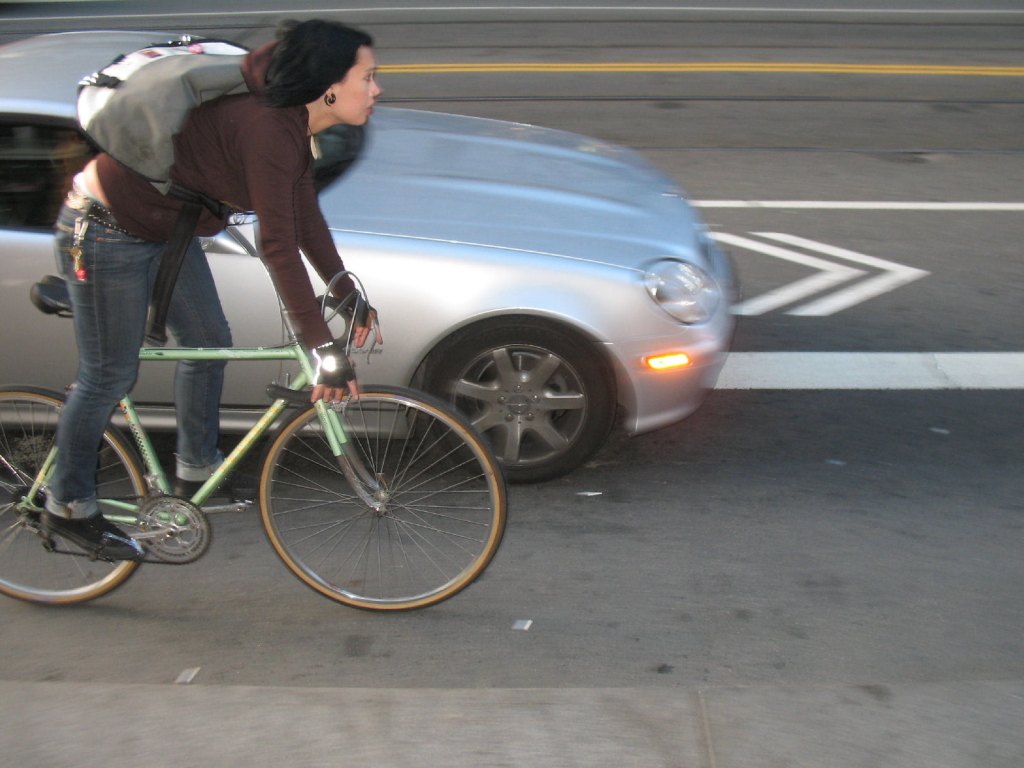
    I’m going to start with the assumption that, at one time and place or another, people who bike have been chastised by people who drive for not “following the rules of the road.”

    I have seen and heard this grievance aired frequently. It has often been presented as an argument against increased bicycle infrastructure. It goes something like this: If cyclists want the “privilege” of using space “designed for” cars, then they must earn it by adhering strictly to the so-called “rules of the road.” I have also personally heard people who drive state that they will not give people on bicycles space or respect on roadways (which translates to refusing to drive in non-life-threatening ways) until cyclists learn to follow said rules.

    Insofar as these are meant to be legitimate complaints or reasonable positions, they are absurd (I add the caveat because I suspect they are not really offered seriously).

    To begin, a petty objection: any complaint from people who drive about the “rules of the road” is invariably hypocritical. Usually distressingly so. One day I’ll do a systematic study, but anecdotally, I’d say that people in cars disobey the rules of the road as often, if not more, than people on bicycles.

    That people on bicycles rarely stop at stop signs (I’m guilty!) is probably the most typical charge from people who drive. The thing is, people in cars virtually never stop at stop signs either. The crux of the matter here, is that cars (and bikes) are meant to come to a full stop. If we are going to lament about transgressions about the “rules of the road,” we must expect firm devotion to the letter of the law. Certainly, people in cars often slow down at stop signs (usually only to the degree that it is necessary to make a turn), but they do not stop. I think part of the reason why people in cars are oblivious to their own routine running of stop signs, while getting enraged by people on bikes committing the equivalent offence, has to do with relative speeds – and simply not understanding what it’s like to ride a bicycle.

    If I’m commuting I probably reduce my speed from 15-20km/h down to 10 km/h at an intersection. The cars however, are slowing down from 40-50km/h down to 10-15km/h. This seems – especially to the person driving the car – as if they are coming to a “stop.” On the other hand, it looks like I’m just continuing apace at a relatively constant speed. I recently had a fairly typical encounter in this regard: At a t-intersection with no cars on the perpendicular street, I came to a stop sign at the same time as a car. We both rolled through the stop sign at the same speed, but the person in the car started yelling me for “running the stop sign.” I explained that he did the same thing, but he could not accept it, insisting that he had “stopped.”

    Beyond running stop signs, people in cars routinely commit a host of other transgressions: they fail to signal, they stop, stand, or park illegally, they block intersections, and turn at red lights without stopping. And let’s not even get started on speeding. Here I want to be very clear: Every single motorist habitually violates the “rules of the road.”

    To reiterate, the issue is not that people in cars follow the rules whereas people on bikes do not. The issue is rather that people in cars ignore their own transgressions but exaggerate those of people not in cars. And the reason for this seems rather basic: most people only get upset about transgressions when it presents an inconvenience.

    To illustrate this, just consider the ways people in cars interact with other people in cars. As long as some infraction of the rules of the road doesn’t cause a perceived inconvenience then it’s tolerated. Indeed, this rationale is taken further: if some infraction of the rules leads to a perceived convenience, then it is encouraged. Hence widespread disregard for speed limits. Most revealing is that the converse is also true. If adherence to the rules is regarded as inconvenient, then it is discouraged. To test this hypothesis, the next time you are driving, try going the actual speed limit, or coming to full stops at stop signs, and see how long it takes before another driver becomes enraged.

    This issue is far more pronounced when bicycles or pedestrians are involved. People on bicycles are legally allowed to occupy a full lane for safety reasons, but if this legal right is exercised, it invariably leads in angry honking and dangerous passing. Similarly, pedestrians have the right of way at crosswalks, but are regularly edged out or honked at by people in cars trying to turn.

    So, most talk of “the rules of the road” is a red-herring, if not disingenuous rhetoric. It typically serves as a means of deflecting discussions from ethical considerations about utilizing public space in responsible ways, to the airing of pretty grievances.

    Presumably, there should be a connection between “the rules of the road” and the ethics of using road space. And presumably, the chief underlying ethical principle directing road laws is that of public safety. This accounts for stop lights and signs, speed limits, speed bumps, pedestrian right-of-way, and the host of other laws meant to encourage safe driving. Careless driving, broadly construed, is against the law.

    This is a point worth reiterating. The “rules of the road,” properly construed, are meant to ensure public safety, not individual convenience. I suspect many a road user are confused about this.

    With all of this in mind, consider another related issue: false moral equivalences placed on different road users. Many a time I’ve been yelled at by drivers for breaking some rule, only to point out that the driver obliviously also committed an infraction, to which the driver often replies, “Well, we’re both in the wrong.”

    But starting with the principle of public safety, the rule-breaking is not equal. Rolling a stop sign in a car is a far greater transgression than rolling a stop sign on a bike, on the basis that the car poses a much more serious risk. Cars regularly kill people. People on bikes very, very, rarely do. Pedestrians crashing into each other, virtually never.

    As the risk to others caused by your use of road space increases, your ethical responsibility also increases. This is why people who drive large trucks require special training and certification. Certainly, vulnerable road users, in the name of their own self-preservation should act in ways that maximize personal well-being, but this does not negate or equate the responsibility of risky (i.e. posing a risk to others) road users (i.e. people in cars).

    This is also not to say that people on bikes or pedestrians are not also acting in ways to maximise their personal convenience. Selfishness is not virtuous, but one must also be concerned with consequences. Being in a car versus being on a bike changes the risky consequences of this selfishness. Moreover, what is “convenient” takes on very different meanings. People in cars are typically selfishly concerned with getting somewhere slightly faster, at great risk to others. People on bikes also break rules to try and get places slightly faster, but mainly at great risk to themselves. This is not meant to be an excuse or justification for silly people on bikes, but there is again no moral equivalence.

    Moreover, people who drive cars probably don’t realise that many of the infractions against the rules committed by cyclists are not done merely in the name of convenience, but are often done to maximise safety. For example, if I can do so safely, I will jump red lights early because it allows me to get away from the mass of cars. I even ride on the sidewalk sometimes (usually in the north of the city where no one walks and drivers are especially horrible), because it’s simply far safer.

    The corollary to the ethics of personal convenience is the ethics of “you’re responsible for your own safety.” From this point of view, cars seem to be the superior mode of transport, because in virtue of the technology that makes them a great risk to others, they are also relatively safer to those that use them. A car on car collision at 40km/h typically does not result in a death for drivers or passengers. A car hitting a pedestrian at 40km/h has a great risk of death. But drivers routinely place more responsibility on pedestrians to not get hit by cars than they do on themselves to not hit pedestrians. This is a inversion (and perversion) of ethical responsibility.

    It is an inversion because it is a fundamentally selfish ethics. It is the same kind of ethics as “caveat emptor,” which benefits no one except people trying to scam you. It is the same kind of ethics that corporations turn to in order to evade responsibility for the risks of their products or practices, which they undoubtedly hawked under misleading pretences. It is an ethics that, above all, is promoted by and serves those in a dominant position. It is an ethics that would be favoured by bullies – the logic that if you are victim of bullying, it is somehow your own fault.

    People in cars, essentially, are bullies (Some? Many? Most?). They dominate by literally threatening your life. And this dominance perpetuates the ethics and logic of the system. Get off the road! Roads are for cars! Either get a car, or risk dying. Insofar as the “rules of the road” reinforce this dominance, the rules are baloney.

    Solutions? The actual enforcement of road laws would be great, but as usual, the issue is largely infrastructural. Thorough cycling infrastructure would require less infractions of the “rules of the road,” but more importantly, undermine the logic that puts the responsibility for safety on vulnerable, rather than dangerous, road users. There could then be a legitimate grounds for talking of individual responsibility when the main factor dictating personal risk is your own competence. If you crash because you’re riding like an idiot in a fully separated, protected bike lane, then, yes, this is your own fault. I don’t doubt that discussions would then turn to the “rules of the bike lanes,” and grievances between cyclists (or pedestrians) would increase, but this is a debate about rules that I would find encouraging.

  • The Latest Front in the “War on Cars”

    DSC07429
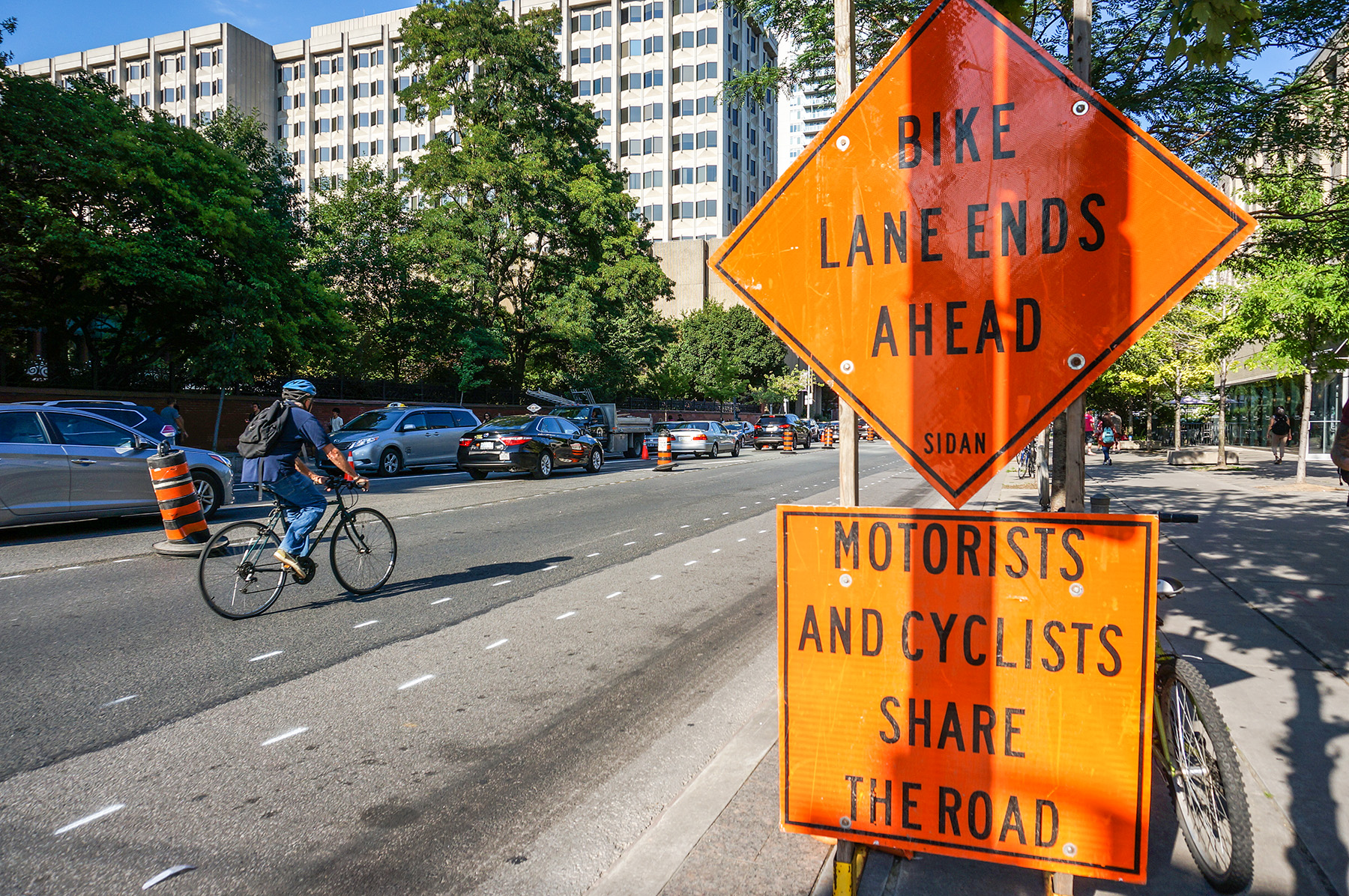
    Bike lanes on Bloor!

    If you live around Bloor Street in Toronto you might have noticed something remarkable today: the commencement of the installation of bike lanes on Bloor. I hope it not too hyperbolic to say that this is a momentous occasion, and as such, I should probably write a positive and optimistic piece. But instead I’m going to sully this event by using it as a platform to address an issue that I am confident that will emerge (or has already, I typically don’t bother reading the relevant media) in the coming days and weeks: the so-called “war on cars.”

    This is a phrase that causes me much consternation and I’ve recently realised why: it is an appalling example of double-think.

    It would be an understatement to say that our transportation system favours travel by single-passenger automobile. More accurately, we should recognise that our infrastructures systemically prioritise, protect, and promote a particular mode of transport, and indeed, a specific vision of human life, one that is so all encompassing that it directs, if not dominates, every facet of North American culture. To suggest that a few kilometres of bike lanes eked out of this wholly car-centric state of affairs somehow constitutes a “war on cars” is patently absurd. It’s like saying that encouraging people to eat a vegetarian meal once a week is a “war on meat” (I don’t dare do a Google search to see if this has already been proclaimed).

    But it is more than an absurdity – it is an irony, a paradox, the holding of a self-contradictory idea without recognising it as such. I know there’s probably a properly psychological concept that describes this more “scientifically,” but this is one of those instances that I have no qualms in appropriating the pseudo-psychology of Orwell.

    The gist of the double-think is that people who speak of a “war on cars” interpret complaints about entitlement (the ubiquitous belief that people have the right to individualised motor-vehicle transportation, coupled with the infrastructural entrenchment of that entitlement) as a case of discrimination. They recognise that discrimination exists, but they believe they are the ones who are being discriminated against. They are simply unable to recognise the structural entitlement that the system grants them (I’d argue a good example of this is the myth that drivers “pay for roads” and non-drivers don’t). I don’t want to overplay the rhetorical might of this analogy, but I think it demonstrates a similar “logic” as to when people speak of “reverse racism” (the analogy isn’t to moral reprehensibility but to how people respond to criticism of entitlement). “Reverse racism” doesn’t exist in any real sense because it misses a fundamental meaning of racism: systemic privileging of one (racialised) group over another. The phrase egregiously dismisses legitimate critiques and responds with indignant reaffirmations of privilege (or as the venerable Doug Ford put it, “Isn’t calling someone a racist, racist?”)

    Anecdotally, I surmise that a good deal of the indignation and defensiveness of people who feel there is a “war on cars” is a reaction to implicit moral judgement. Just as our car-centric infrastructure reflects values, so too does non-car-centric infrastructure like bike lanes. And it is precisely in the context of the dominance of cars that this value judgement riles so deeply: why would any one ride a bike (or walk or take the subway) if cars are so superior? What, are these people too good for cars? Do they think they’re better than me? But my car costs so much money! I think this points to a partial explanation of why regular car-users deride other forms of transportation as some sort of moral failing. Consider, for example, the oft-exclaimed idea that only poor, unsuccessful people would ride a bike or take a bus – I don’t know how many times drivers have told me to “get a job and buy a car.”

    Thus, in response to this moral judgement, rather than confronting the fundamental question at hand – should I be driving a car? – the discussion turns to sanctimonious nit-picking about the “rules of the road,” ad hominems, silly platitudes about “no one being perfect,” red-herrings (“but what about the elderly and delivery trucks?”), and self-assurances that car drivers are no worse than anyone else. This last point may well be true, except for the decision to drive a car, which is the moral question at hand.

    But here too the racism analogy might be instructive. Many discussions about racism are hobbled by the fact that people fail to recognise that racism is both a structural problem and one of individual ethics. So too with questions of transportation infrastructure, and socio-technical systems more broadly.

    Driving a car regularly, as your chief means of transportation is an enactment of a structural and systemic entitlement. This doesn’t mean that individuals who drive regularly are morally “bad” people – not simply as a result of driving, at least. Cars can legitimately be viewed as a necessity. People are born into a car-centric world and have little to no choice but to participate in it. Abstinence is possible in certain contexts, but not most. So, in this regard, the necessity of cars, and the individual behaviour of driving, is structurally determined. But again, car-centrism isn’t wholly technological. Even if it weren’t extremely difficult to access parts of our built environments without cars, people are guided by the societal assumptions that link cars to notions of progress, freedom, prosperity and success. Car commercials, basically. Cars are imbued with deep symbolic values. And hence the phrase, “the war on cars.” When you suggest alternative means of transportation, it is perceived as an attack on these values.

    Such accounts do mitigate in some sense individual moral culpability (or maybe they don’t, but that’s too big an issue to address here). But such explanations do not absolve responsibility, rather, they give it a broader scope. Cars are necessary, yes, but this is a necessity of our own making, one borne out of a long series of interrelated choices and reflecting certain values and dispositions. Recognising that the issue is structural (literally, in the sense of infrastructure), then the individual ethical responsibility turns to supporting alternative infrastructures – ones with far fewer social and environmental (and I’d argue cultural and economic) costs. Questions of individual behaviour are not entirely displaced (there are certainly many trips by car that are completely unnecessary), but individual behaviours need to be understood as structurally determined.

    I don’t expect such arguments will be exceptionally persuasive to those committed to driving cars (and hence the need to build physical infrastructure). There will still be enormous resistance – such is the result of trying to change any system, especially those that entrench a (selfish?) way of life. Perhaps, though I speculate quite liberally here, the obstinacy and tantrums are a psychological mechanism to deal with the cognitive dissonance created by the dawning realisation that cars are not inherently superior – that one’s cherished beliefs, beliefs that might legitimately be called dogma, are actually dependent on a specific set of constructions. It’s as if drivers are terrified there might be better means of transportation. As if a thorough and efficient multi-modal transportation system, one that prioritises public and environmental health, is a cause for deep existential concern. If infrastructure looks different, the inherent superiority of cars disappears. At least that’s what would be dawning on me if I was stuck in traffic as cyclists happily glide by in the new bike lane.

  • Performance Enhancing Drugs and the Limits of Human Nature

    As far as questions of ethics in sports go, cycling has been one of the most pronounced sources of moral dilemma. While the nature and cause of these dilemmas might seem obvious, it’s worth it to briefly recite them. Sports are supposed to be fair. Fairness is typically construed to mean that no participant should have access to any means that gives them an unnatural advantage over others. Performance enhancing drugs are a widespread source of an unnatural advantage; using them constitutes an ethical transgression. The playing field is not level, so to speak.

    One view of the issue regards PEDs as cheating. Some cheating is merely arbitrarily written into the rules of the sport. The baseball pitcher who uses a foreign substance on his hand is breaking the rules, but the rules could easily allow such substances to be used. The act is regarded as cheating because it is against the rules, not because there seems something inherently wrong with using tree sap on one’s fingers to get a better spin on a ball. In cycling, there are all sorts of rules about equipment and clothing. Certain kinds of wheels are banned, even shoes and socks. It’s only cheating if one gets away with transgressions of the rules in a clandestine way. But the UCI could simply allow blades on wheels, for example, and no one would think there was something fundamentally antithetical to the notion of competitive sports in the use of that technology.

    But can the same be said for PEDs? Whenever the issue comes up in cycling, or any other sport, there are always a few that suggest that PEDs should just be allowed, thus concerns about fairness are bypassed. And amongst cyclists who have used PEDs themselves, many have argued that their use of PEDs wasn’t to gain an unfair advantage, but to ensure that no one else had one. The view, and it needs to be said that there is some truth in this, was that everyone was doping. One was being put at an unfair disadvantage by not doping, rather than gaining an unfair advantage. So, if everyone was doping, or if everyone were allowed according to the rules of the sport, would doping still be an ethical transgression?

    Performance enhancing drugs seem different than other forms of cheating. The moral indignation induced by them is not reducible to the fact that they are against the rules. Yes, PEDs are against the rules. But there’s a deeper opposition to them. As a thought experiment, imagine that technological prosthetics existed that improved human performance. That you could get a mechanical implant in your legs to make them stronger. I doubt this would be accepted, even if every participant had such an implant.

    Let’s return to the opening point about fairness. The peculiarity about talking about fairness in sport is that sports are inherently unfair. Sport seems to be one of the most conspicuous exhibitions of innate natural ability in human culture. Indeed, that is a key element of their appeal. Inequality in other realms of human society can be understood to be largely a result of a wide array of social determinants; even if some outstanding inherent individual ability is present, it is but one factor among many accounting for success – in school, or business, or careers, or relationships – and often relatively insignificant. One can easily understand how a wealthy business person and a homeless person might exchange places if their fortunes had been different, with no changes to their innate aptitudes.

    Professional sports is exceptional in that it congregates so many outliers in the same place. The relative success amongst these outliers can be attributed at certain times and places to (typically marginal) meritocratic differences, or even social determinants (though the broader demographic characteristics of professional cyclists is relatively homogeneous). But the awe of watching Froome and Quintana in the mountains, or Kittel and Greipel in a sprint, or Sagan doing his thing, can be attributed to a realization that these are gifted human beings. No perfect alignment of social and environmental factors would ever allow us mere mortals to accomplish the feats of these athletes. The issue of “nature vs. nurture” (a false dichotomy to be sure) is so deeply perplexing because it seems so irreducibly complex. Sports are so captivating because in many ways it gives us a simplistic view of human nature.

    PEDs sully this view. They violate a fundamental impetus of sport. Sports are supposed to be about pushing human abilities to their natural limits. This is why the thought of hidden motors in bicycles is so repugnant. It has nothing to do with natural ability. It violates the fundamental expectations of human performance, what makes it inspiring, what makes it authentic, what makes it real.

    7465532722_b13b501bf1_b.jpg
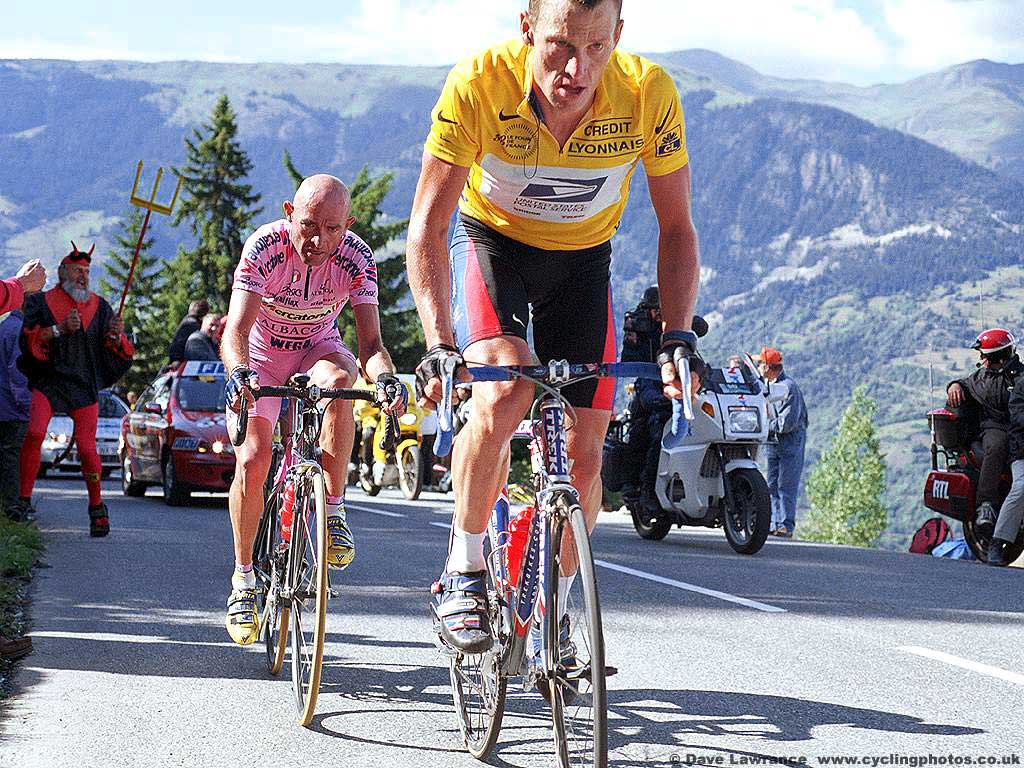
    A Faustian Bargain? Pantani, Lance, and the Devil

    But, as captivating as this view is, it is, as I say, simplistic. Sports are a keen reminder that genetics obviously matter, and that in some realms, they matter probably more than anything else. But one should be wary of blowing the horn of genetic reductionism too confidently. Sports are experiments that isolate certain variables over others, but they are not pure reflections of innate genetic endowment or natural physiological aptitude. Glimpses perhaps, but glimpses through a complicated lens.

    Natural ability is of course part of the equation, but not in any unadulterated, pure sense that makes the use of PEDs a clear transgression of a boundary between natural and unnatural performance. The logic (and the chief empirical criteria) against banning PEDs is that they enable physical achievements that would not be possible without their use. Chris Froome’s recent Tour de France feats have been scrutinized about whether they were “within the realm of human performance.” There have been numerous attempts to objectively quantify this realm. Apparently 6.1 watts per kilogram marks the limits of human nature.

    But what is natural about people riding on heavily engineered pieces of technology, wearing lab-tested garments, and engaging in a host of scientifically and technologically mediated behaviours that humans would only engage in in the context of a thoroughly socially-constructed sport? Even if we externalize the technology and say that it is independent of the human, a means to reveal one’s natural ability – in the same way a microscope reveals the deeper structure of organisms – what exactly is being revealed? Genetics and physiology are in there somewhere, but so are hours upon hours of training on machines made to shape human bodies in a particular way, training which is itself based on scientific knowledge about human nutrition, physiological responses to stress, biochemical reactions, biomechanics, all which is mediated through machines to measure concentrations of various compounds in human blood, or maximal rates of oxygen consumption, or maximum power outputs. All of this information is quantified, analysed, and turned into protocols to be fed back into the system.

    PEDs are conspicuous in their boundary pushing because of their acute effects. It is a variable one can isolate among many. But take out any of the plethora of artificial factors listed above, and what kind of performance would be possible? One can extend this question beyond the arena of sports. What is natural about anything humans do? Would the limits to which humans push themselves be possible without the entire apparatus of modern society? Take away mass produced agriculture, genetically engineered foods, vitamin and micronutrient supplementation, vaccinations, pharmaceuticals, and a host of other health related technologies. Take away the systems of knowledge and technology that mediate, structure, and intervene in our lives, and what are we left with? Probably not a group of highly trained professional cyclists defined by VO2 max, watts per kilogram, and hematocrit levels.

    Human beings continue to break records. Is this because we are getting closer and closer to the pureness of human nature? Or further away from it?

    While I’d love to leave that question lingering, lest I be accused of condoning performance enhancing drugs, I should state that there is indeed a very compelling rationale for banning PEDs. Namely, they pose significant health risks, risks that I don’t think can be seen as an acceptable cost of merely wanting to compete in sports at an elite level. But that points to another moral quandary: If PEDs existed that posed no significant health risks, that safely expanded the realm of human ability, what would be the grounds for their restriction?

  • Bikes Lanes on Bloor and the Suburbs: On Dependency and Freedom from Cars

    201638-bloor-bike-intersection.jpg

    Those of you who don’t live in Toronto are unaware, but a previously unfathomable thing came to pass on Wednesday. Toronto City Council voted in favour of a pilot project for bike lanes on one of Toronto’s major (if not the major) thoroughfares, Bloor Street. The rallying call of “Bike Lanes on Bloor” from cyclists over the last decade always struck me as mostly symbolic, if not a bit tongue-in-cheek. In car-centric Toronto, it just never seemed possible, no matter how much one hoped, that the city would ever put bike lanes on such a major road. There is much left unsettled (it’s just a pilot) and no doubt limitations (it only covers a short 2.6km stretch of the road), but there is much to be happy about. This seems a step in the right direction for addressing issues of transportation, environment (both natural and urban), and public safety. If it points to future vision of Toronto, I wholeheartedly support the pilot.

    Expectedly, support for the project was not unanimous. Three councillors voted against it, all from Toronto’s “inner” suburbs. But why would councillors, whose constituents live nowhere close to the proposed pilot area, vote against such a project? Etobicoke councillor Stephen Holyday offered his rationale: “I’m here actually to stand up for the people of the west end of the city who are going to be directly impacted. This blocks the people from the west end from getting in and out.”

    Holyday represents Ward 3 in Etobicoke, which you would recognise as a collection of fairly typical suburban neighbourhoods: mostly single family homes on large lots, nestled in cul-de-sacs, with major arterial roads, and a collection of strip malls along these roads. In other words, it is a quintessential car suburb. Apart from a few bike lanes on a non-major roads, and some rec-trails in the ravine system, it is a rather unwelcoming place for bikes – that is, if you are actually trying to get anywhere.

    Suburbs are designed for cars – they are essentially required if you wish to get anywhere, and the surrounding infrastructure, e.g. strip malls, are made to accommodate cars. But there’s something about the design of suburbs that people often don’t consider – they’re created to simultaneously facilitate car use and shelter people from their externalities. Suburban cul-de-sacs – the residential blocks whose roads form a loop and have no thoroughfare traversing them – are designed to discourage traffic. This is a major reason why people want to live in suburbs. They are quiet, kids can play hockey or basketball on the street, people can be outside on their lawns, and not have to deal with cars zipping by their homes, with all the associated noise, risk, and pollution. Ironically, this makes suburban residential streets pretty safe for biking –  but only for the kinds of bike rides that parents go on with their kids, namely, meandering around nice quiet roads with minimal car traffic. The catch is, if you actually want to use bikes as a means of transportation, you’re out of luck.

    Another minor but important point: it is a fairly wealthy ward, with the median household income being substantially higher than the rest of Toronto. The majority of the people who live in this ward are home owners, living in single family homes.

    Given all this, I find Holyday’s comments fairly objectionable.

    The relatively privileged people who live in suburbs (the ones who can afford single family homes) also tend to be the same people who oppose densification of their neighbourhoods, on the grounds that it will increase automobile traffic (I grew up in one of Toronto’s “inner, inner” suburbs in North York, and opposition to new apartment buildings and condos was vociferous on this precise point – increased density would lead to cars on side streets). So why is it difficult for these people to understand that others also want to decrease traffic in their neighbourhoods? That people who live in the city’s core also want to be protected from the risks of cars?

    Holyday sees Bloor Street primarily as a means for people to get in and out of Etobicoke. Certainly, it has multiple functions. But Holyday is relatively unconcerned with those other functions. And in its capacity as a thoroughfare, isn’t it reasonable to prioritize those who use it most frequently? Namely the people who live in its adjacent neighbourhoods? These people rarely drive to their destination. Most walk, others bike.

    Many people who live in the suburbs are inconsiderate of this issue. Those who comfortably live in quiet, safe suburban neighbourhoods (and that they aggressively protect from any development that might jeopardize that quiet safety) don’t understand what people have against cars, because, paradoxically, in being so dependent on the car, they externalize its ill effects to others. Everything outside of the tiny enclave where they do not use their car (maybe no more than a one kilometre radius around their home) merely appears to them as places to drive. They do not recognize that the spaces that they primarily see as conduits to get them to and from their safe and quiet neighbourhoods are actually places people live.

    This is one of the ironies of the suburban vision. There is undoubtedly an attitude of self-sufficiency in the suburbs (just consider Rob Ford’s attitude towards “downtown elites”). People want to live quietly, according to their own devices, and in relative isolation. But ultimately, this isolation – and the car dependency it requires – must be accommodated by everyone else.

  • “It’s Not Like Riding a Bike Will Change Anything”

    Untitled-1.jpgI suspect a recurring theme on this blog will be: what’s the point? My inaugural post starts by facing this existential question. In a world where free-will seems dubious, or at least impotent in the face of powers beyond one’s control, and where one’s actions appear so insignificant and futile, what of ethics?

    I’ve routinely encountered detractors who, while seemingly not in the midst of existential crises, have expressed doubt, if not disdain, of the personal ethical decisions of others (usually mine) on the grounds that they are pointless.

    “It’s not like riding a bike is going to make a difference,” I’m told.  Well, it depends.

    If the universe, in a broad sense, is deterministic, then what could it mean to have ethical responsibility? If everything is predetermined and our choices illusory, then it doesn’t matter what we do one way or another. We certainly cannot be held ethically responsible for our actions. Or, put another way, we can’t have moral duties. But, the issue is not about fatalism, but rather the relative scope of effects.

    When someone chastises that some individual action on its own will not have a discernible effect, they may be correct. And the powerlessness of our actions are, in effect, a product of determinism. The direction of society, large-scale problems, the world as it is and which we are born into, are determined by factors out of our control. This is not a philosophical determinism, nor wholly a physicalist one. It is rather a reflection that agency is contextual and relational, and that in most people’s contexts and relations, their agency is relatively limited.

    So whence come moral responsibility? Do we have a moral duty to act in ways that maximize effects? Are actions that have small or negligible consequences imbued with less moral might than actions that have broad effects?

    Consequentialist theories of ethics are, of course, a major area of concern for moral philosophers. What makes an act morally right? Intentions? Consequences? Something else? As with most things, when it comes to ethics, I’m a pluralist. Consequences matter, but so do intentions, and so does context. The scope of possible answers is too expansive to cover here, so I’ll just focus on one aspect of this problem: what does it mean to “make a difference?”

    A key consideration in answering this question is the casual relationship between individual and collective acts. It does not make descriptive or explanatory sense to think of a group of five people carrying a large object as equivalent to five individuals carrying five smaller objects, but yet, the individual acts are integral to the collective product. Most large-scale human projects cannot be enacted by individuals, even hypothetically. City-infrastructure, buildings, complex technological systems – these are all collective enactments. Similarly, structural societal problems like poverty or pollution are collective enactments. This is to say, they are not reducible to individual acts that have been multiplied; they are qualitatively distinct. But paradoxically, it is an individualistic consequentialist ethics that leads to the broad structural problems we face. Because a problem like climate change, for example, cannot be reduced to individuals’ carbon emissions, people can thus rationalize, “I’m not causing the problem.”

    So when it comes to seemingly negligible ethical acts (like riding a bike), it is the collective act which becomes the point of reference for evaluating ethics, since the collective act is that which effects the desired consequence – whether it be lower CO2 emissions, safer streets, less pollution, increased public health, or a happier community – not the individual act per se. Thus, a sort of conditional ethics presents itself. If many individuals rode bikes, then what would be the consequence? This is a more suitable question for evaluating one’s individual actions than say, “What is the effect of one person riding a bike?” It provides a way of recognizing that seemingly negligible acts can indeed “make a difference.” And even if the conditional is not fulfilled – even if you’re the only one riding a bike – the act is nonetheless ethical.