• Etiquette and Infrastructure
    1280px-Cyclists_at_red_2
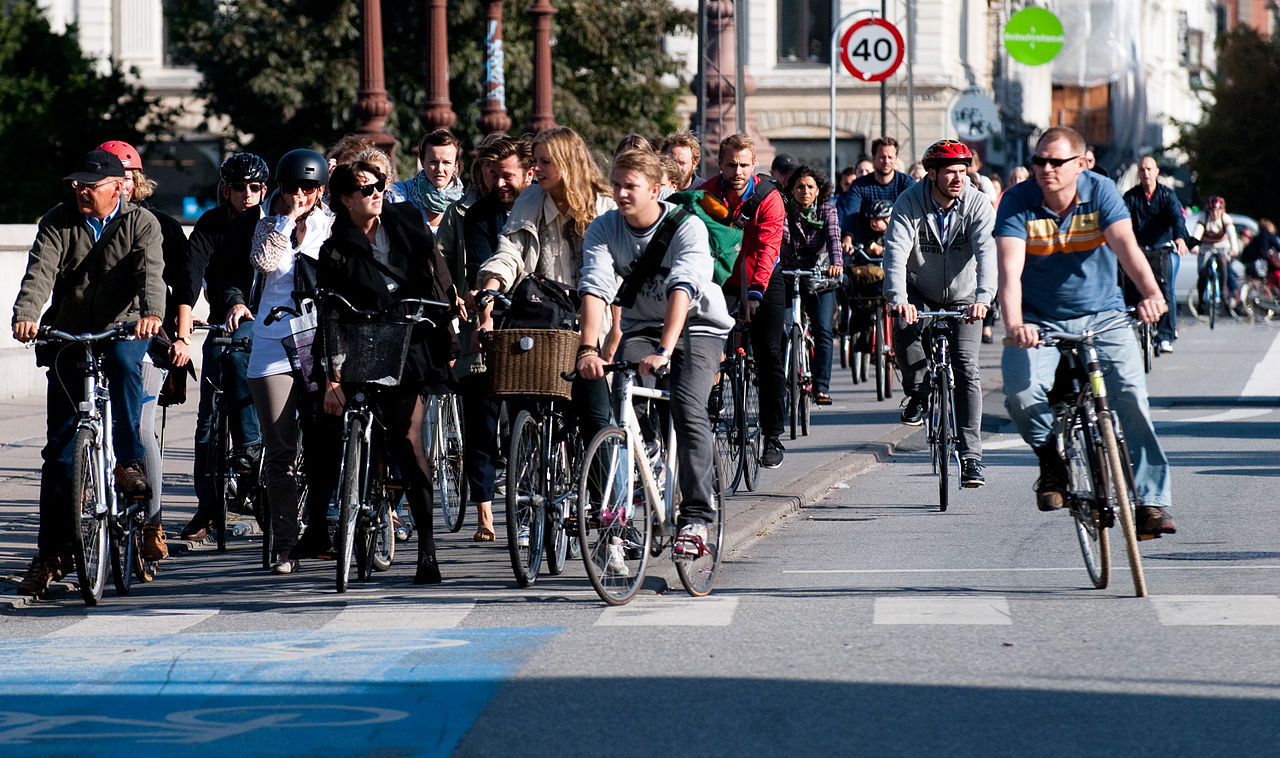
    Commuters in Copenhagen

    In Toronto, where I do most of my biking, bike ridership is growing, but a fully-fledged bike culture has yet to emerge. I mean this in as broad a sense as possible. There are certainly cyclists, and bike scenes, and various cycling-subcultures. But cycling has yet to become fully integrated into the fabric of the city. A large percentage of the cyclists on the road are relatively new cyclists, and are fairly inexperienced at cycling amongst others. As such, one of the chief defining factors of a culture, namely, an accepted set of behavioural norms, has yet to be established. Many questions of etiquette present themselves.

    Of the many issues of bike etiquette that I debate with my cycling friends, the issue of the pre-emptive pass (henceforth PEP) has been particularly controversial. Most people who bike have experienced this at some point or another: you stop at a red light next to the curb, and another cyclist pulls up next to you on your left, with the clear intent of over-taking you once the light turns green. (As with most facets of biking, this phenomena has been explored by Bike Snob NYC, which he dubs “shoaling” (which is frankly kind of an obscure term to use) to denote the collection of people each attempting to pre-emptively pass the other. I personally rarely see more than one person at a time attempt the PEP, but occasionally I will see two. But three cyclists side by side does not a shoal make).

    By pulling up next to someone at a light, you are non-verbally announcing your intention to pass them, implying that you are a faster rider than they are. And therein lies the question of etiquette. It is in many regards, rude. This is undoubtedly the source of many Cat-6 races, as some cyclists view the PEP as a challenge, if not an outright affront (I personally admit to going for the holeshot against someone trying the PEP on me). For these reasons, I used to never attempt a PEP on other cyclists; I would properly line up behind the other cyclists waiting at a light. Once the light changed and the paceline started, if I found the pace was too slow, I would then pass the cyclist(s) in front of me.

    One day I chastised a friend for doing a PEP, he made the case that the PEP is a far safer way of passing people. The argument is hard to dismiss. Passing people while moving invariably puts you at risk from moving automobile traffic, and generally forces you to pass them at a closer distance. It’s a more involved procedure. If there are several people you wish to pass, this only increases your risk from cars, as well as increasing the chances of Cat-6ing, as each new person you pass might try to match your speed and disallow the pass. The PEP on the other hand allows you to firmly establish your place in front of (non-moving) automobile traffic and you only have to worry about one Cat-6er, the person at the front of the line.

    So, I started doing PEPs a little more often. But as with most questions of social etiquette, performing a pre-emptive pass in an acceptable way requires a sort of tacit judgement (whether something is rude or not is often ambiguous to me). First, you have to have good reason to suspect that you are going to pick a pace faster than the person you are going to PEP. For example, if I’m closing a gap on a cyclist and then we both end up at a red light, that’s a safe bet. If the cyclist is already stopped, I let them set the pace and then pass if necessary. If I’m on my road bike on a training ride, I almost always PEP. So far I’ve avoided Cat-6s and dirty glances. Most commuters seem perfectly happy to allow me to PEP. These are the kinds of unwritten rules that one gleans through experience.

    However, I’ve personally seen a number of egregious PEPs. Doofuses on slouchy 26″ MTBs moving to the front of a long line of commuters only to be passed on the inside by all of them. And I have seen horrible Cat-6s emerge. Things get especially dicey when a person tries to PEP another PEPer. These scenarios increase risk, rather than lessen them. And the PEP is just one of many possible examples of such issues. I expect transgressors will multiply as ridership numbers continue to increase.

    There are some general ways of creating a friendly, cooperative, safe bike culture. Questions of etiquette tend to revolve around a broad social concern: what would be the consequence if everyone acted in a particular way? Obviously, if everyone was an over-zealous pre-emptive passer, chaos would ensue. So, viewing PEPs as poor cycling etiquette seems to be a fair generalization. There are exceptions to any rule, as the examples I gave above, and those tend to be context dependent. When in doubt, however, revert to the general rule.

    But etiquette is also linked to infrastructure in crucial ways. Of the many things that people on bikes do that motorists (and pedestrians) can’t stand, most are chiefly a function of poor infrastructure. Riding the wrong way on a one way street, riding on the sidewalk, passing on the right of cars at lights (another form of pre-emptive passing), “taking up a whole lane” – all of these can be addressed by improved infrastructure for people on bikes.

    Likewise for pre-emptive passing. If bike lanes are wide enough to allow for two lanes of bike traffic, then the issue of the PEP becomes diminished. Passing in general is facilitated, so there is less of an urge to pass pre-emptively, and two lanes of traffic based on pace are established, making it less likely that a cyclist will be stuck behind one riding more slowly. In Copenhagen (check the pic), for example, I never observed any of these issues. No Cat-6ing, no pre-emptive passing. And this is a result of ample cycling infrastructure. There’s more room for people to bike, so cyclists are not constantly struggling against one another.

    So, while questions of etiquette superficially seem to involve interpersonal acts – acting nicely or rudely towards another person, our built environments can encourage or discourage certain behaviours. We quite literally build our etiquette – our social values – into our infrastructure. So, the solution, as usual, is to build more and better bike lanes!
  • Why do People Make Fun of Spandex Bike Clothes?

    fcb19edb7d9abd970ecadcf0c8d55b2f.jpg
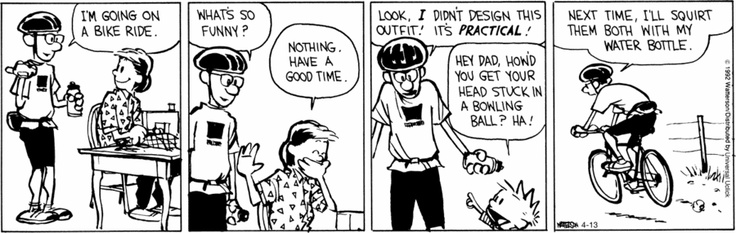
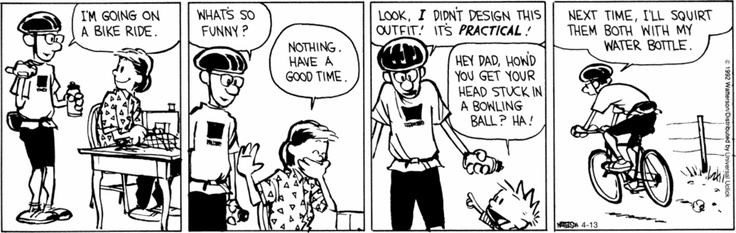
    Steven Herrick at the Guardian wonders: Why do people make fun of spandex bike clothing? It is a peculiar phenomenon for cyclists. When people find out that I’m “a cyclist” (which is often how I get introduced in social settings by friends), I routinely get asked, “You’re not one of those people who wears tight bike shorts, are you?” When I reply in the affirmative, I get variations on perplexed or even disgusted looks.

    I’ll answer the question with a provocation: People who make fun of spandex are often homophobic and/or sexist.

    I’ve encountered this on numerous occasions, firsthand. Now, it’s hard to distinguish between general homophobic bigotry aimed at cyclists (because riding bikes is “gay,” get it?) and that specifically directed at the adornment of tight spandex cycling garments, but as evidence for the latter I submit the following anecdotal evidence: Once, apropos of nothing, a person in a car leaned out of their window and yelled, “Nice tights, f****t!”

    (I’ve actually being called, “f**,” “f****t,” and “gay,” on numerous occasions by people in cars while riding my bike (seriously!), but they hadn’t made any specific comments about my extremely functional, comfortable, aerodynamic spandex clothing).

    Even in the “cycling community” (if this is a thing) there are those who make fun of spandex. And this too is often tinged by homophobia or sexism (bigots typically aren’t narrow in their shittiness). Anecdotally, it appears that the split between pro- and anti-spandex cyclists falls along disciplinary lines. Downhill mountain bikers, for example, virtually never wear spandex. And some will make fun of road cyclists for being “spandex wearing pussies” (actual quote from a message board). Amongst messengers you will also find a sharp divide between those who wear performance biking attire and those who steadfastly refuse (as evidence I offer the documentary film, Premium Rush).

    This issue isn’t unique to cycling attire. In a classic Simpsons episode, Bart ends up in a ballet class. He’s embarrassed at the idea of wearing ballet tights, because “ballet is for sissies,” and “dancing is for girls.” And as trite as that reference is, that’s a large part of why people – even cyclists – make fun of spandex bike clothes. And this is inevitably gendered. A man wearing tight shorts? That’s “girl’s clothing.” It’s “gay.” (The same kind of attitude revolved around tight jeans until somehow shitheads too decided that Levi’s 511s were cool.) And of course, women are much less reluctant to wear tight cycling clothing, because it looks pretty similar to the clothes they already typically wear.

    Latent homophobia and sexism emerges even more conspicuously when it comes to the issue of shaved legs. Here I don’t want to enter into the debate about the functional benefits of shaved legs for bike racing, but undoubtedly one of the reasons that male cyclists are so reluctant or refuse to shave their legs is because it is something that “men don’t do.” When people find out I shave my legs (Wait, what? You shave your legs?), some are noticeably weirded out. I’ve met men who spend thousands of dollars on aero wheels and helmets, though when the issue of shaved legs arises (which is arguably the cheapest aerodynamic advantage one can obtain), it’s met with looks of disgust. This issue would be better addressed in a separate post (e.g. one exploring questions of masculinity and body hair), but since I’ve started shaving my legs for cycling, I’ve become intrigued by this sexist double-standard. Women are expected to shave their legs just as a matter of course, and in the few cases where it is “acceptable” for men to shave their legs, it’s justified in some instrumental way that can be reverted to other tropes of masculinity (e.g. shaved legs help you win races).

    Of course, most people who ride bikes don’t have any reason to wear spandex (or shave their legs). Spandex bike clothing is obviously designed, and most functional, for certain kinds of riding. I don’t wear a skinsuit when I’m taking my beater to the bar or a friend’s party. Sitting around in a chamois is extremely comfortable when actually riding a bike, but when one sits down on an actual chair for extended periods of time, not so much (one might describe it as a “diaperish” feeling.) And besides comfort, in most social situations you don’t really want to be wearing bike shorts, any more than you would want to be wearing swim shorts. It’s just a matter of fashion.

    There are also less bigoted reasons for making fun of or refusing to wear spandex. There’s the perceived coolness (or lack thereof) of spandex. It wreaks of trying too hard. If you’re not a competitive cyclist, the argument goes, do you really need to be wearing performance clothing? And much spandex-hating is better understood as body-shaming. There are people who look like they’re supposed to be wearing performance bike clothing, and those who allegedly don’t. Brits have a pejorative acronym capturing this: MAMIL (middle-aged man in Lycra). Finally, undeniably, there’s a modesty issue. It’s the reason why white bike shorts are a faux-pas. Bike shorts are revealing. (But even in this case, there might be a bit of homophobia at play? “What if I look down and see the outline of male genitals?!?”).

    This post isn’t a bit of spandex advocacy (ok, it kind of is, spandex is awesome). People can wear whatever they like. It’s just a shame that people are missing out on wearing extremely comfortable, functional cycling clothing because of latent sexism and homophobia. Well, that’s a bit of an overstatement. The real shame is the latent sexism and homophobia, which creeps up in all walks of life.

  • On Bicycles and Philosophy, or, Why I Write

    After struggling for years to come up with a relatively focused topic to write about, I’ve finally stumbled upon one. It was actually pretty easy, I just combined my two favourite things: bicycles and philosophy.

    So, yeah bicycles are cool, but what’s the point of philosophy?

    I return to this question periodically at times of heightened cynicism. The question could be phrased even more broadly and more cynically: what’s the point? For a (ersatz) philosopher I am rather sceptical about the effectiveness of doing philosophy as a means of engendering action.

    One the one hand, maybe it doesn’t need to engender action. One can, at the very least, learn new things or think about things in new ways. There’s plenty of philosophizing to be done that can be open-ended and exploratory. And again, bicycles are cool. Sometimes I just want to talk about bicycles in a somewhat interesting way. Not all philosophy needs to be overtly critical.

    But there’s also plenty of philosophizing that is explicitly normative. Questions of epistemology. Questions of ethics. The general problem is this: how do we establish effective relationships between critical perspectives and effective action? One might call this a problem of theory and practice.

    The first part of the problem is trying to establish what would count as critical perspectives. “Critical thinking,” such that it is, is a predominantly outward act. The internet is rife with shameless accusations of idiocy. The form of outward critique can increase in sophistication, but people continue to be unabashedly convinced of the superiority of their point of view, while talking past others. Everyone has experienced or witnessed the utter futility of trying to “debate” someone on the internet.

    There are some obvious solutions: knowing the facts (and recognizing the limits and uncertainty of those facts), considering multiple points of view, avoiding motivated reasoning and confirmation bias, pronouncing your views tentatively and with humility, and most importantly, turning one’s critical gaze inward rather than outward. It may sound banal, but if everyone read more, and said less, the state of commentary would be improved.

    Paradoxically, it is precisely the recognition that people should be more conservative and less self-confident in their viewpoints – that everyone should post less bullshit – that compels me to write. Ideally, it would be great if arrogant know-nothings weren’t given media pulpits to spout nonsense (or better, people didn’t actively and intentionally present misleading information and disingenuous arguments). But since they are (and they do), I feel compelled occasionally to offer a counter-argument.

    There is enough evidence to show that people do change their minds, at least on some things, and at least gradually. This is more clear on a population levels than on individual levels. One routinely sees horrible ideas take hold and proliferate. Counter-arguments may not eliminate these ideas, but can at least stem their propagation. And even if we take a cynical view of the public, one in which public opinions coalesce around predominant messages rather than good arguments, it at least seems worthwhile to simply play a tactical game of counter-messaging to bad ideas.

    One way of putting it is that winning an argument might be futile, but positively shaping public discourse is possible. Small effects matter too. In any case, abstinence doesn’t seem to be an option, or at least, one that is tolerable to me (I have my limits, however; I’ll probably never engage in discussion in the comment section of a major news website).

    The second part of the problem is at least as insurmountable: even if discourse was broadly improved, what would be the effect? It seems that a robust understanding of some problem is neither a necessary nor sufficient cause of action. For example, how many people who are taking personal action on climate change (like riding a bike instead of driving a car) have a thorough understanding of it? Or conversely, how many people who have good understandings of problems take concerted actions in trying to fix them?

    So, all this points to why I am always anxious and reluctant to write anything. Yet I persist, perhaps inexplicably, or perhaps because I accept as an article of faith that occasionally ideas make a difference.

    petitbi-from-nigel-land.jpg
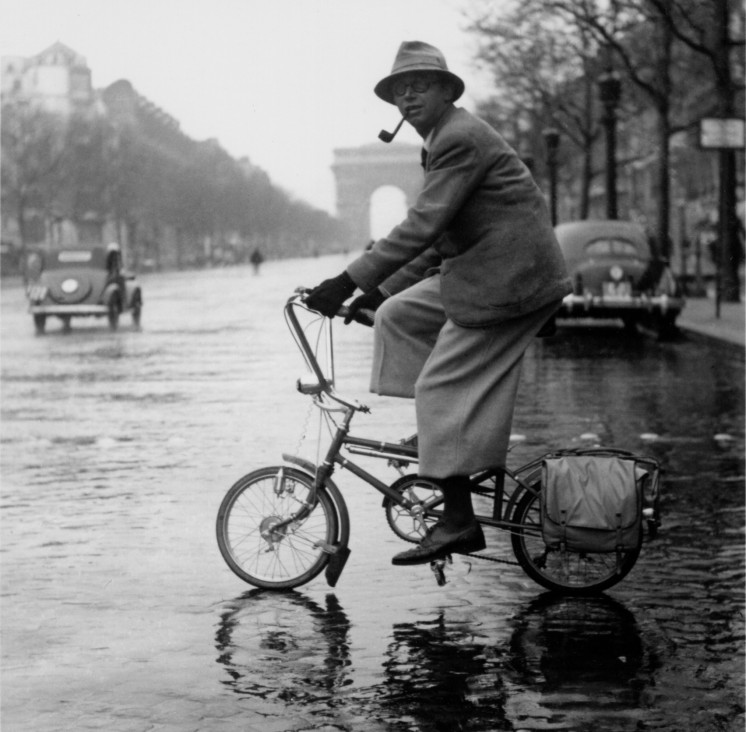
    Sartre riding a bicycle. Image source.

    Ok, but what does all this have to do with bicycles?

    The combination of bikes and philosophy isn’t completely arbitrary. I do some of my best philosophical contemplation while riding my bicycle. And like any widespread human activity, cycling can provide a basis for exploring a range of philosophical issues. But cycling presents more than a source of test cases for general philosophical problems; it offers unique philosophical questions in itself.

    For example, the history of bicycle manufacturing offers rich opportunities to explore the notion of technological progress. In the form of the bicycle we encounter an ongoing (I don’t want to say dialectic, but I’m going to say it anyway) dialectic of efficiency and aesthetics. The history of bicycle racing allows us to explore another conception of progress – that of human advancement. And as with any sport, questions of fairness arise, though bike racing has been conspicuous in this regard.

    But cycling as sport represents only one of many manifestations of how bicycles have been used, and many have rallied against cycling as a means of competition. Again we encounter questions of aesthetics, but less to do with the form of a bicycle and more to do with the representation of self. A host of cultural attitudes about authenticity, coolness, and fashion follow. And these are just recognizably bourgeois concerns.

    Different cultures have diverse conceptions of the meaning of bikes and bicycling. There is of course the utilitarian nature of the bicycle. It serves as a means of transportation of both persons and goods, and a means of livelihood, if not survival. Thus, it is not hyperbolic to say that through cycling we can explore some of most fundamental assumptions that shape our lives: assumptions about beauty, progress, human nature, and quality of life.

    Finally, bicycle riding in so many ways can be conceived of as an ethical act, or at least one with ethical consequences. It allows us to test the very organization of our societies, to challenge the limits and explore the possibilities that we give ourselves.


  • The Conference Board of Canada Greatly Overestimates the Degree to which Drivers Cover Road Costs

    Recently the Conference Board of Canada released a study that claims that upwards to 90% of Ontario road costs are covered by drivers. The purported findings of the study were gleefully touted by all major news sources, and if one was careless enough to read appending user-comments, one could expect that they were rife with remarks of smug self-satisfaction and entitlement, and perhaps claims of moral superiority in the horrific “war on cars.” I was immediately sceptical of the findings because previous studies have estimated, on a national level, that driver-related revenues covered upwards to 64% of road costs, and I argued that even this was probably an overestimate.

    Predictably, most of the media reports did not pay close attention to the ranges (often just reporting the 90% figure) and methodologies used, nor did any of them spot or comment on any of the obvious issues in the study. I figured this was typical journalistic inaccuracy and sensationalism. But then I read the press release on the Conference Board of Canada’s website. It leads off by claiming “Majority of Ontario Road Infrastructure Costs Paid by Motorists.”

    This is a false statement. (more…)

  • The Publicly-Funded Convenience of Cars

    Like most issues, people engage with transportation mainly in an individualistic way. Hence most “debate” about transportation infrastructure, as in this predictable piece, merely amounts to recounting a set of personal anecdotes such as seeing cyclists riding on sidewalks, without extrapolating any broader insights beyond expressing one’s peevishness. Maybe this is just systemic – people are “inherently” selfish (or encouraged to be so), and have great difficulty considering some issue beyond their immediately personal wants and experiences – say on a societal or structural level. Whatever the case may be, what’s frequently missing from the constant stream of indignant rants about transportation (and even transportation debates by our finest politicians) is a discussion about what the relative societal benefits (and costs) are of differing transportation schemes. What kinds of transportation systems and urban planning are most efficient, affordable, safe, and least damaging to human and environmental health? (more…)

  • Do Cyclists Pay for Drivers’ Use of Toronto Roads?

    The insinuation that cyclists do not pay for roads (with the further implication that motorists are paying for cyclists’ use of roads) is a well-worn refrain from motorists who are unenthusiastic, to say the least, about sharing road space with people on bicycles. The main thrust of the cyclists-are-freeloaders argument stems from the notion that roads are chiefly paid for by revenue schemes that are dependent on the production, sale, and operation of cars. Motorists pay licensing fees, fuel-taxes, and in some places, car-specific sales taxes and registration fees, and drivers assume that it is these forms of funding that pay for their roads.

    I have suspected for some while that it is largely an empty argument, as people have taken this question up with regards to other cities and found that cyclists do indeed pay for roads – but I wanted to know the specifics of the situation in Toronto.

    Far from it being the case that cyclists do not pay their fair share for road infrastructure, the opposite appears to be the case: cyclists pay disproportionately more than motorists for their use of road infrastructure.

    In Canada, highways are typically paid for through provincial and federal funding. A portion of this comes from motorized-road-vehicle-specific taxes, like fuel-taxes and licensing fees, though precise data about how this money is spent on a province-by-province basis has proved inaccessibly hard to come by. However, there is some very general information available. In the fiscal year 2009-2010, the combined levels of all governments in Canada spent $28.9 billion on roads, and collected $16.5 billion in combined permit and license fees, fuel-taxes, and other revenues. This study estimates on this basis that road-user fees cover about 64% of road costs Canada-wide, but this is a massive overestimate.

    Crucially, the total revenue gathered from transport-specific sources does not specifically go into roads. Road spending amounts to 73% of the total $39.5 billion spent on all forms of transportation infrastructure Canada-wide (if you take away federal spending, the amount spent on roads rises to about 81%). So, if we assume that revenue use corresponds to total spending (that is, 73% of total revenue is earmarked for roads), we can roughly estimate that perhaps transport-specific fees cover about 42% of the cost of roads. But, this might also be an overestimate, since it’s clear that revenues are not earmarked for specific expenditures based on their source (that is to say, the money gathered from car-specific sources is not spent exclusively on car-specific infrastructure – nor is it clear how much revenue is generated from car-specific sources). For example, nearly $1 billion of transportation revenue comes from sources that are not used by cars at all, such as airport leases, harbour fees, and selling of assets. Furthermore, motorized-road-vehicles (cars, trucks, motorcycles) are not the sole contributors to fuel-taxes. Boats, snowmobiles, dirt-bikes, ATVs, lawnmowers, and so on, all use gasoline and thus use of these vehicles contributes to fuel-tax revenue. And of course, boaters and snowmobilers also pay licensing and permit fees which go into transportation revenues.

    However the specific numbers are crunched it is evident that motorized-road-vehicle-specific revenues do not come close to covering the cost of roads. With this in mind, I’m going to turn to the particular example of Toronto.

    In municipalities, road-vehicle-specific revenues amount to a tiny fraction of funding sources for road infrastructure. Whereas provincial and federal governments collect licensing-fees and fuel-taxes, municipalities typically do neither (though Vancouver has a fuel-tax; there has been concern that such local taxes actually encourage driving as people drive outside a municipality to find less-taxed gas, but the evidence for this is scant). In Toronto, the revenues collected from the hated Personal Vehicle Tax (the one that Ford repealed) wasn’t even earmarked for transportation. In general, cities fund road infrastructure in the same way they fund everything else – with property taxes.

    There are certainly other sources of driver-specific revenue, such as fees from paid-parking, but these are only used for operating costs, not capital costs. And even in this regard, they only make up a small portion of total revenue. In 2011 in Toronto, total revenue from sources specific to motorized-road-vehicle use amounted to only 22% of all transportation-related revenue. The rest comes from recoveries from private capital projects like new developments, sundry revenues, like the sale of assets, and transfers from reserve funds. In total, transportation-specific revenues fund 41% of operation costs, in which case, driver-specific user-fees (and in fact not even all user fees are driver-specific, some are paid for by developers or business owners) fund about 9% of the total City of Toronto transportation operating costs.

    But operating costs don’t even cover the building of new roads or the major renewal of old ones. Operating costs pay for street-cleaners, snow-plows, the fixing of pot-holes, the maintenance of street-lights and street-signs, and so forth. Road-building falls under capital costs, virtually none of which is paid by driver-specific revenue sources. In Toronto’s long-term transportation plan, approximately 88% of capital costs will be paid for through debt-financing. And this debt will be paid off primarily with property taxes, as this is the major source of revenue for the city of Toronto. The amount of driver-specific revenue that will go into paying for new road infrastructure is negligible.

    The key thing to take away from this number crunching is that road infrastructure is subsidized. Firstly, the user fees that drivers pay obviously don’t come close to covering the cost of their driving, and thus have to be paid for through other sources (on provincial and federal levels, typically sales and income taxes, and on municipal levels, property taxes). Furthermore, the total per-capita contributions that the average driver makes to transportation costs, including property taxes, doesn’t come close to covering the cost of their driving. We have a socialized transportation system. Todd Litman’s aforementioned study tries to give a rough estimate of the actual costs of driving, and I’ll use his numbers here (though you’ll notice if you look closely that he actually errs in some of the calculations – though I make the necessary corrections here – and some of his sources are unclear. In any case, we could to this same exercise almost wholly hypothetically).

    Litman estimates that in general (though the costs would certainly be higher in a major city like Toronto), the cost to local governments of maintaining infrastructure for cars is about 6.3 cents per mile travelled (despite his study being Canadian-centric, he still uses miles because a lot of his background data were from US studies). Of this, only 0.7 cents is covered by driver-specific revenue. Thus, 5.6 cents per mile is covered by general taxes (in the case of a city, it would be property taxes). So, let’s say a driver who has driven 10000 miles in the last year pays $300 in total taxes that will end up being used for roads. The total cost of the driver’s driving on the road system will be $630. The driver’s user fees contribute $70. So, the driver has paid $370 towards road infrastructure, but has a total cost of $630, and so the cost of the driver’s driving has been subsidized by $260.

    Ok, now we can finally get to bicycles. Bicycles obviously exert less costs on road infrastructure. Even if every part of Toronto’s road infrastructure was left intact and maintained, bicycles would still cost far less than cars for the simple fact that they cause virtually no damage to roads. But if you adjusted the road infrastructure to meet the needs of cyclists only, then the costs would be drastically less. You would need far less space. Roads would be smaller. You wouldn’t need parking lots. You could sell off an enormous amount of assets. You wouldn’t need as many stop lights. You would arguably require less traffic patrol. And so forth. Litman estimates that the roadway costs for bicycles to be about 1.6 cents per mile (though it’s not clear if this is an estimate based on maintaining existing road infrastructure that only bicycles would use, or if this is how much it would cost if cities only needed to build bike specific infrastructure). So, a cyclist who pays the same amount of taxes and who travels the same distance as the above driver, ends up costing the government $160, and thus subsidizes road infrastructure by $140. (Of course, cyclists also tend to live closer to their work and thus travel less miles than drivers).

    And none of this even includes the cost of externalities. The cost of congestion in the GTA is estimated at $2 billion! Not to mention insurance costs related to crash risk. Or the vast infrastructural and health costs of pollution. Or climate change, if you believe in that kind of thing. Litman estimates that if you factor in externalities, cars actually end up costing governments $29.3 per mile.

    In the case of Toronto, given a cyclist and a driver that pay an equal amount of property taxes, it is likely that the cyclist actually subsidizes the driver’s use of roads. In any case, it is abundantly clear that the average driver is definitely not paying for the average cyclist’s use of roads. 

    In the end, who bears the brunt of the costs has nothing to do with cycling or driving per se, but as with all socialized programs, with who is paying the most taxes. I suspect that cyclists in Toronto (people who use bicycles as their primary or only source of transportation, and probably don’t own cars) probably pay less property tax per-capita than drivers, since cyclists on average likely have less income and less expensive homes than motorists. But overall, it just comes down to who has a higher-valued property. The driver and the cyclist with a really expensive house are both subsidizing the poor driver’s and the poor cyclist’s use of the roads, though the driver is being subsidized to a far greater degree. And the poor cyclist is closer to covering his or her road costs than the poor driver, and the wealthy (or expensive property-owning) cyclist is over-paying his or her road costs to a higher degree than the wealthy driver.

    Two conclusions:

    First, insofar as road infrastructure is necessarily socialized, in that the majority of drivers would refuse wholly user-pay solutions, cycling is indisputably the more responsible (if responsible means less-dependent on government welfare) mode of transportation. Rich luxury-SUV-driving jerks shouldn’t be disdainful of cyclists, they should be thanking them for causing less of a tax-burden.

    Second, if for some reason you feel entitled to yell like an asshole from your car at some cyclist to get off the road, be sure that you at least pay more property taxes than they do.